
Janet
Location: Oakland High School (1023 MacArthur Blvd, Oakland)
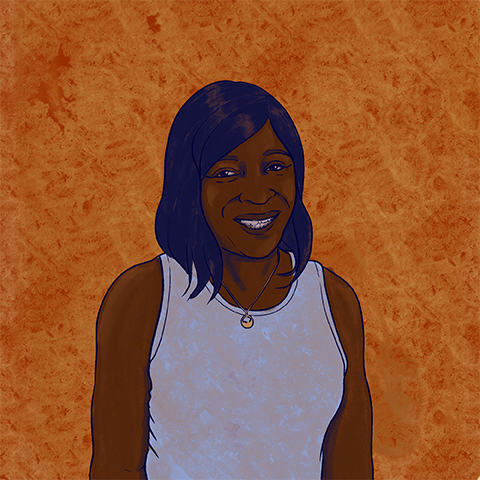
Janet Halfin, born at Highland Hospital in 1956 and raised in Oakland, was the first male-presenting student to participate in modern dance at Oakland High School. This, along with other experiences, led to her being sent to a psychologist to be “cured.” Instead, she instead found an escape through military service. Janet later worked as a Department of Defense Police officer and became a founding member of TransVision at Tri-City Health Center, where she served as a Medical Assistant and Health Education Specialist in Alameda County’s only program for transgender women. She was honored with a Trans Visibility Award from the Oakland LGBTQ Center and also works as an ER nurse at San Francisco General Hospital.
Hear the story
Read the story
-
My name is Janet Kimberly Halfin, a.k.a. Lady Janet Halfin. I'm a resident of Oakland, California, born and bred. Been here most of my life. The only time I left Oakland was when I was in the military. Oakland is my home. I'm like the A's, I'm rooted here. Every place that I've been, I always turn around and come back home. That's because this is where I'm known. This is where my family is. This is where my heart and my roots are. And ain't nothing like the root and the heart of The Bay. I was born November 1956. I was born at Highland Hospital. My mother's name was Pearl. My father's name was Joseph. I have siblings and they are Lila, Ricky Leonard. We were a big happy family. Growing up, I kind of stayed to myself. I guess it was just me in general, but then I started noticing that I had a feminine side of me. And so really when I was a young age and about 6 or 7, I started exploring it. My mom and siblings, they would go places and stuff and I would say, 'Oh, I'll stay home.' And I had models that I would build. So they let me stay home and build models and in the meantime, after I get too tired of building my model, I would dress up and stuff. I got caught. I got caught, got a whopping, took me to a psychiatrist. And the psychiatrist, we went back and forth for like a couple of months, like about 3 or 4 months. And when he said, 'Oh, you're cured,' I said, no. And he tried to convince me, 'oh it's just a phase, it'll be okay.' No, it's not a phase, it's me. And I knew that. There was no ifs, ands or buts about it. And it slowly but surely showed itself. And I'm not ashamed. I'm not ashamed. This is me. And I'm proud of myself.
And then when I got into high school, I kind of knew what was going on with me. So I figured the safest place to be was in modern dance. Because I tried to play football. I ran track then, was good for me. Football, I was okay, but I was too small. So I basically just said, I'm going to go to modern dance and I like to dance. So I fought, scraped, me, my mom, my dad, and then we ended up going to fight with Oakland and the School District. Cause this was unheard of back then, we're talking about the 60s and 70s is unheard of. Somebody being of male gender or male-presenting, quote unquote, going in to be in modern dance that was girls and all this other stuff. So when I was at Oakland High, ended up being in modern dance. I was the first male-presenting person in modern dance. I basically hung out with the girls. It was comfortable to me. I would get there to class early. We would all be sitting around by the balancing beam, I'd be laying on the balancing beam just sitting up there chilling. We'd be kikiing and kaka. And the guys used to get mad at me because, 'oh, you're going over there with our girlfriends.' 'No, your girlfriends are my partners.' [Laughs] So I know a lot about y'all that ya'll don't know. Right. And it got to be a fun thing because the guys were always like, 'oh, well, what does such and such...' I'm not getting in that. Leave me out of that, okay. I got my own issues. And it was really fun time with me. My instructor, she was very, very warm, accepting and loving. She kept me in the male presenting roles but she kind of knew on the side. So she didn't press 'em too much and she let me be me. And that really kind of helped me come out.
-
Then there was the Vietnam War. I ended up going into the service. That was a totally different animal because I wanted to go into service and I was in ROTC. But me going in service was my way to like get away. So I could get away and be – graduate, get out, be on my own. I could do me. Went in the service and had fun, I had fun. I got overseas. Didn't nobody know me. I was basically in heaven. And my biggest thing in the service was they used to have these books called Flag Brothers and they had platform shoes and all the latest 70s hot outfits. And I would always flipped through the lady's section. I'd be in the lady's section I'd be like, 'Ooo look at that one.' And I'd pick out my outfits and I had some bad outfits. I had this long maxi coat, a pair of platform heels, and I had a mini skirt with a halter top that came to a V top down in the middle and honey thought I was it. I had a little scarf on my head because I didn't have a Afro-cause I was in the service. I had to tie a little scarf over my head, tied it to the side. Oh, I was hot stuff. I was hot. And it was fun, you know, cause didn't nobody know me. So when I got off base, I went one way partners and all the other guys went the other way. And so if they saw me, I'd be in the club. The clubs were so dark they wouldn't know it would be me. And we'd be in there partying and stuff and didn't nobody notice. But the service taught me a whole lot of stuff. And I learned to be independent. I learned how to deal with stuff on my own. And I learned to take the good with the bad. Of course, there's always the bad.
And then I ended up leaving and coming back here and it was like, 'uuuuuh, here we go again. We got to go through this again.' But I had to learn how to play both sides of the fence. Being – they just called us transvestites – being back, you could get beat up. You could get shot at, you can get shot. You can get killed. And so I end up getting married, one to my high school sweetheart. Which lasted and we had a couple of kids. But still in the back of my mind, I had those female tendencies. I helped each one of my wives get dressed like, 'Oh, no, you need to put this on in. This goes with this. Oh, you look cute, girl.' And they was like 'oh, how do you know?' 'Don't worry about it. Don't worry about.'
I ended up losing one of my kids. That was a hard time for me. And at that time, I was really battling with being who I am now. And I had to tell myself, it's either you're going to be Janet or you gonna stay the other person. You can't keep going back and forth, back and forth. Because number one it's expensive [laughs] because you got to get stuffed and throw it away and get stuff and throw it away. No, that's too much money. And number two, I had to be true to myself. I really did. And that was the biggest heartbreak of all because everybody already knew that I was kind of transitioning. They are already pushing me away. I was by myself. I was out on the streets. And Lord knows, all of us girls, we hit the road every now and then, you know, got to make our coins. Because that's our only next survival method other than being in a beauty shop and doing nails and all this other stuff. With that, I just kept pressing forward because I didn't want to be on the streets. I wanted a place of my own. I didn't want to do nails. Definitely didn't want to work at a beauty shop. So I just fell back on some of my military training. Started working for the federal government. I worked for the Department of Defense Police as a federal police officer. I spent five years on all the military bases around in the area. When they closed the bases, I was kind of at a loss. So I moved out to Hayward. Kicked it out there with a couple of my friends, I was still homeless out there. And believe it or not, that commercial from Everest where the guy says, 'what are you doing? You're just sitting on the couch. Try to do something with your life. Come on, be a medical assistant.' I was like, I know medical, I'm pretty good at medical. So I became the ambassador of my class and became senior ambassador overall. Graduated, ended up working at Tri-City Health Center for TransVision as the medical assistant in the medical phase TransVision. I worked on PrEP, I worked making the Brandy Martell Project cause Brandy Martell was one of our coworkers, my sis, my friend. She was killed in August 2012 in downtown Oakland. We made a program and it helped the trans community in the Bay Area. And I just won't say in the Bay Area, but in the world itself, because we became international. And Tiffany Woods, which was my boss, she helped me go through this stuff and she helped TransVIsion grow. And we as a team built TransVision. Me, Tiffany, Kayla, Terry, Erikka, Lorena, we all did it. Our clients came in, they came in and they'd seen us. They were glad to be there. They were glad to see us. They were happy in everything that we did. Then we started getting awards, we started getting notoriety. It just kind of flourished from there. It's not stop yet, and I don't anticipate it for to stop.
Right now, I'm getting ready to be trained as a basic life instructor. In other words, I'm taking CPR trainings to be a CPR instructor. I'm just going to keep going up my ladder and in emergency medical care. And who knows? You might come up to the General sometime and then see me flash by or something. It's just the nature of the beast. I love what I do. And I wouldn't have it any other way.
-
It took me years to realize that it's a process. And I'm thankful for the journey, even though no matter how bumpy and rocky it was, I'm thankful for it. Because number one, it made me a better person. It's opened my eyes to a lot of things. I've seen how people are. In the trans life, no, it's never going to be a bed of roses. We go through a whole lot more than most people think we go through. If it's not from family, it's from work and this one trying to be home. Home is the most important thing. If you don't have a place, you don't have no place to be centered, you still kind of lost because you're still trying to get yourself into this. You can have a job, you can have a nice little cushion that you think is someplace. But if it's not home, you just staying with somebody or you sleeping on somebody's couch, you crashing in a motel, that's not home. Even though you got you a job and it's paying you beaucoups money, if you ain't got home where you can go and kick back, relax, then you kind of feel kind of 'I'm not home.' When you have somebody that you love, that can be home. That's what I found now.
The world is different because the powers that be are no longer in power. Their power is kind of like dwindling. They're old as dirt, so they're kind of like leaving. Also, even though it doesn't seem like the trans community is powerful, we are still a force. Because you're starting to see more and more of the upper echelon come out. Kaitlin Jenners, these people are starting to come out, in their side of the fence. And they're like, 'I didn't know that.' That's because you turned a blind eye. 'Oh, no, Jim Bob will be all right.' No, Jim Bob ain't all right. Jim Bob ain't all right until Jim Bob get in that miniskirt and them heels [laughs]. Then Jim Bob is just fine. Jim Bob ain't Jim Bob. Jim, Bob is Betty Sue. [Laughs]. So, I mean, it's gonna take a little while longer. But I got a funny feeling we're going to see more of our trans sisters and brothers in positions of power. We're going to see them in the mayor positions, the governor positions, the congressional positions, the senatorial positions. May even see some up there with the department-of tacked on to their names. Being the chief-of. There's endless possibilities. We're like the phoenix. We've risen from the ashes, and we constantly grow. Cause there's no stopping us. We have set a pace, not just for ourselves, but for everybody. It's like, be yourself. Be yourself, be yourself, be the best that you want no matter what you do.
I'm very proud of myself, and I'm proud of the woman that I am. It has its ups and downs and I still go through my occasions every now and then. But I've learned how to deal a lot better with situations than I did in the past. I've learned how to navigate through things. I'm very connected to the LGBTQ center. That's my crew. That's my crew right there. I love them to death and they do a good job and they're solid in the Oakland community. They just gave me an award a couple of weeks ago for trans visibility. And I was shocked. I was like caught off guard. And it was very warming to see all my peers and former clients that are now in the community doing the work that I was doing, actually acknowledging me and giving me an award and giving me attention and recognition. And I was I was touched. I was very, very touched. And I love them to death for what they did. And I want 'em to keep up the good work because I'm gonna keep up the good work. I'm doing something positive. And it's kind of like just keep on doing what you do.